
- All
- Product Name
- Product Keyword
- Product Model
- Product Summary
- Product Description
- Multi Field Search
English
Views: 0 Author: Site Editor Publish Time: 2026-09-03 Origin: Site


In modern metal casting, the bottleneck rarely lies in pouring; it almost always occurs in the cleaning room. Inefficient sand removal directly impacts throughput and profitability. Foundries face a critical decision in post-casting processing. Relying on standard shakeout processes risks leaving residual sand in complex internal passages. This leads to catastrophic part failure and high scrap rates. Conversely, over-investing in specialized equipment inflates capital expenditure without guaranteed returns.
Resolving this bottleneck requires a technical evaluation of how your casting geometries interact with mechanical force. Standard vibration simply cannot clear intricate water jackets or convoluted hydraulic channels. This guide breaks down the operational realities, mechanical differences, and financial trade-offs between a standard shakeout machine and a dedicated Decoring Machine to help you specify the right equipment for your production line.
Purpose Divergence: Shakeout machines are designed for bulk external sand and mold separation, whereas a decoring machine is engineered specifically to break down and evacuate complex internal sand cores.
Casting Complexity Dictates the Choice: Simple castings with open geometries can often be fully processed by a high-efficiency shakeout machine. Castings with intricate internal cavities (e.g., engine blocks, cylinder heads, pump housings) strictly require a decoring machine.
Operational Trade-offs: Decoring machines require a higher initial CapEx and more complex maintenance (due to multi-axis rotation and pneumatic hammering) but drastically reduce scrap rates and manual rework on complex parts.
Integration Reality: These machines are frequently complementary rather than mutually exclusive; high-volume foundries often utilize a shakeout machine for primary separation, followed by a decoring machine for precision internal cleaning.
Effective sand removal dictates the success of all subsequent downstream operations. When core sand remains trapped inside a casting, the financial consequences compound rapidly. Residual sand acts as a highly abrasive contaminant during the machining phase. It destroys expensive CNC tooling, accelerates spindle wear, and ruins surface finishes. If a partially blocked internal passage escapes the foundry undetected, it causes catastrophic field failures. A blocked water jacket in an engine block leads to overheating, triggering massive warranty claims and severe reputational damage.
Foundries must establish strict baseline metrics to evaluate sand removal efficiency. Subjective visual inspections fail to provide actionable data. You must track hard metrics to justify equipment upgrades. The primary key performance indicator is the cycle time required per casting to achieve complete sand evacuation. This dictates your overall line pacing and determines whether the cleaning room starves the machining department.
Secondary metrics include the sand recovery rate. Efficient systems reclaim a high percentage of core sand for thermal or mechanical regeneration. Environmental health and safety metrics demand equal attention. You must monitor decibel levels to ensure OSHA compliance and measure ambient silica dust concentrations. Finally, evaluate energy consumption. Track the kilowatt-hours required per ton of metal processed to understand the true operational burden of your cleaning room equipment.
Performance Metric | Measurement Method | Target Outcome |
|---|---|---|
Cycle Time | Seconds per casting from load to unload. | Match or exceed the pacing of the primary molding line. |
Sand Recovery Rate | Percentage of total sand weight reclaimed vs. lost. | >95% recovery for closed-loop thermal regeneration. |
Internal Cleanliness | Endoscopic inspection or weight-based verification. | Zero grams of residual bonded sand in internal cavities. |
Acoustic Output | Decibel meter readings at a 3-meter radius. | Below 85 dB(A) to comply with standard OSHA regulations. |
Energy Efficiency | Kilowatt-hours (kWh) per ton of processed metal. | Minimize peak electrical draw and compressed air waste. |
Shakeout machines serve as the primary workhorse in most green sand and no-bake foundries. Their core mechanism relies on high-frequency, high-amplitude vibration. Heavy-duty eccentric motors generate kinetic energy that transfers through a rugged steel deck. This violent vibration breaks the thermal and chemical bonds between the molding sand and the exterior of the newly poured casting. The process rapidly disintegrates the external mold, allowing the bulk sand to fall through a perforated grid for reclamation.
The dynamics of this vibration dictate the machine's effectiveness. Lineal, or vertical, vibration provides an aggressive upward impact. This vertical smashing action excels at fracturing heavy, rigid sand masses and breaking down large molds. In contrast, pivotal or elliptical oscillation combines vertical impact with horizontal movement. This elliptical motion helps convey the casting across the deck. It continuously loosens external sand while moving the part toward the next stage of the cleaning room.
Shakeout decks are ideal for specific use cases. They excel in high-volume green sand lines producing iron or aluminum castings with simple geometries. If your product mix consists of manhole covers, brake rotors, or basic structural components, a well-tuned shakeout deck provides sufficient cleaning power. They process multiple castings simultaneously, offering unmatched bulk throughput. You simply dump the molds onto the deck and let the eccentric shafts do the heavy lifting.
However, standard vibration has severe physical limitations. Kinetic energy travels in straight lines. It fails to penetrate convoluted internal passages, blind holes, or narrow water jackets. The vibration may fracture the internal core sand, but without a clear exit path and directional force, the broken sand simply vibrates in place. It remains trapped inside the cavity. Relying on a shakeout deck to clear complex internal cores inevitably forces operators to perform manual chiseling and air-blowing, destroying production efficiency.
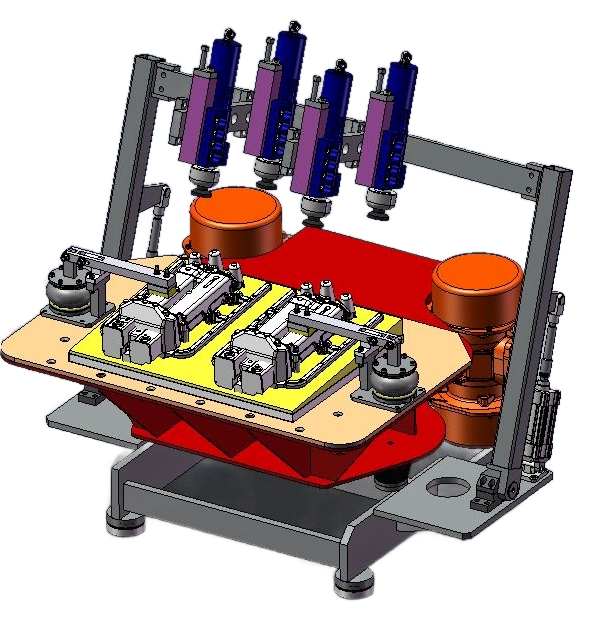
When standard vibration fails, foundries must deploy advanced mechanical approaches. A Decoring Machine utilizes a combination of targeted kinetic forces to destroy and evacuate internal cores. These systems employ pneumatic hammering to deliver rapid, localized shocks directly to the casting. This high-frequency chiseling shatters the hardened resin-bonded sand inside the cavities without damaging the metal structure.
Simultaneously, the machine utilizes multi-axis rotation. The casting is clamped securely into a fixture and tumbled through 360 degrees. This rotation is critical. It constantly changes the orientation of the internal passages. Gravity works in tandem with the pneumatic hammering. As the internal core fractures, the rotation ensures the broken sand flows out of the complex exit ports. You cannot rely on vibration alone to move sand uphill; rotation solves this physical barrier.
This level of specialized equipment becomes mandatory at a specific threshold of casting complexity. Automotive cylinder heads, engine blocks, aerospace housings, and complex hydraulic valves feature intricate internal geometries. These parts contain narrow, winding passages that are impossible to clear with standard vibration. If your foundry produces these components, manual decoring is financially unsustainable. The scrap rates and labor costs will quickly outpace the capital investment required for automated solutions.
The combination of rotation and vibration creates optimal sand evacuation dynamics. Standard shakeout merely loosens sand. Dedicated decoring equipment physically forces the sand out. The pneumatic hammers break the chemical bonds of the core binder, whether you use cold-box, hot-box, or furan resins. The continuous rotation aligns the internal cavities with gravity. Localized high-frequency vibration keeps the pulverized sand fluidized, preventing bridging or clogging at the exit ports. This synchronized mechanical action guarantees a clean internal cavity, ready for precision machining.
Selecting the right equipment requires comparing specific operational dimensions. You must evaluate how each machine handles your unique casting geometries, production volumes, and facility constraints. A mismatch here leads to either a starved production line or excessive capital waste.
Evaluation Dimension | Shakeout Machine | Decoring Machine |
|---|---|---|
Primary Function | Bulk external mold separation and primary sand reclamation. | Precision destruction and evacuation of internal sand cores. |
Casting Handling | Bulk processing on an open vibrating deck. Continuous flow. | Individual or batch fixturing. Secure clamping required. |
Optimal Geometry | Simple, open castings with minimal internal coring. | Complex parts with blind holes and winding internal passages. |
Energy Draw Profile | Continuous, high-kilowatt draw from large electric vibratory motors. | Peak-load electrical draw combined with high compressed air usage. |
Maintenance Focus | Vibratory springs, heavy-duty bearings, and perforated steel decks. | Pneumatic hammers, rotational drives, and custom clamping fixtures. |
Shakeout systems are built for bulk processing. Castings dump directly from the molding line onto the vibrating deck. Multiple parts process simultaneously as they travel down the line. This requires zero precise handling. Conversely, a Decoring Machine requires exact positioning. Each casting must be securely clamped into a custom fixture. The fixture must withstand violent multi-axis rotation and aggressive pneumatic hammering without allowing the part to shift or suffer surface damage. If the clamping force is too low, the part ejects. If it is too high, you risk warping an aluminum casting.
Throughput models differ drastically. Shakeout decks operate on a continuous-flow basis. They keep pace with the fastest molding lines, processing tons of metal per hour. Decoring operations function as batch processes. Loading, clamping, tumbling, hammering, and unloading take a specific amount of time per part. High-volume foundries often run multiple decoring cells in parallel to match the overall output of their primary shakeout lines. You must calculate the exact takt time of your molding line and scale your decoring cells accordingly.
Energy profiles impact long-term operational costs. Shakeout decks rely on massive electric motors running continuously. This creates a steady, high-kilowatt power draw. Decoring systems have a more variable energy profile. They require electrical power for the rotational servo motors and massive volumes of compressed air for the pneumatic hammers. You must calculate the cost of generating that compressed air when evaluating the true efficiency of the system. A drop in plant air pressure will immediately stall a pneumatic decoring cycle.
Safety profiles contrast sharply. Open shakeout decks expose operators to extreme ambient heat, violent vibration, and severe noise. Manual intervention on a shakeout deck carries high ergonomic risks. Modern decoring systems utilize enclosed, automated cells. The operator loads the part outside the hazard zone. The cell doors close, isolating the operator from kinetic hazards, acoustic trauma, and dangerous silica dust exposure. This isolation drastically reduces workplace injury claims and improves overall operator retention.
Maintenance teams must prepare for different wear patterns. Shakeout maintenance focuses on structural fatigue. Teams constantly inspect vibratory springs, replace massive eccentric bearings, and weld cracks on the heavy steel deck. Decoring maintenance is more precise. Technicians rebuild pneumatic hammers, replace worn clamping pads on fixtures, and service the complex rotational drive mechanisms. Both require rigorous preventative maintenance schedules to prevent catastrophic downtime. Ignoring a worn pneumatic chisel will eventually lead to inadequate sand removal and spiked scrap rates.
Equipment selection extends beyond mechanical capabilities. Foundry managers must weigh conceptual trade-offs that impact the entire business model. The most significant debate centers on capital expenditure versus operational savings.
The upfront cost of an automated decoring cell is substantial. It requires precision engineering, robotic integration, and custom tooling. However, you must frame this CapEx against the long-term reduction in OpEx. Manual decoring requires a small army of operators wielding air chisels. It is slow, inconsistent, and highly prone to ergonomic injuries. Automating this process eliminates those labor costs. More importantly, it drastically reduces the scrap rate of fully machined parts. Saving a single batch of complex engine blocks from the scrap bin often justifies the equipment investment.
Foundries must also evaluate how to upgrade outdated equipment. Transitioning from legacy shakeout decks requires strategic planning. A full replacement of the primary shakeout line disrupts production for weeks. Often, a complementary retrofit yields a superior return on investment. Foundries retain their existing shakeout deck for primary bulk separation. They then install a dedicated decoring cell offline. This hybrid approach handles evolving casting complexities without requiring a massive overhaul of the primary molding line.
Footprint and line integration present physical challenges. Shakeout machines integrate directly into the existing conveyor flow. They occupy a linear footprint. Decoring equipment requires dedicated spatial planning. These machines operate inside acoustically enclosed cells. They often require robotic loading stations, staging conveyors, and dedicated dust collection ductwork. Finding the floor space for an offline decoring cell in a crowded foundry requires careful facility engineering. You must map the material flow to ensure the new cell does not create a forklift bottleneck.
Deploying heavy foundry equipment carries inherent operational risks. Proactive mitigation strategies ensure a smooth installation and protect your workforce.
Acoustic and environmental compliance is the most pressing challenge. Both shakeout and decoring processes generate extreme noise, often exceeding 100 decibels. They also release massive quantities of respirable silica dust. You must integrate robust acoustic enclosures around the equipment. High-capacity dust collection systems are mandatory. Baghouses must pull sufficient cubic feet per minute (CFM) to maintain negative pressure inside the decoring cell, preventing silica from escaping into the broader facility. Undersizing your dust collector will lead to immediate OSHA violations and rapid equipment wear.
Tooling and fixture costs often surprise foundry managers. A decoring system requires custom-machined clamping fixtures for every unique casting geometry you produce. If your foundry runs fifty different complex parts, you need fifty different fixtures. Mitigate this hidden cost through modular fixture design. Engineer base plates that accept interchangeable clamping jaws. This reduces the machining costs for new product introductions and minimizes fixture storage requirements.
Operator training must evolve alongside the equipment. Moving from a manual shakeout deck to an automated cell requires a shift in workforce skills. Operators no longer wield pry bars; they interact with HMI screens. They must understand CNC and PLC programming. They need training to recover from robotic faults and troubleshoot sensor errors. Invest heavily in vendor-provided training during the commissioning phase to prevent unnecessary downtime caused by operator error. A well-trained operator can diagnose a pneumatic fault in minutes, whereas an untrained operator will simply shut the line down.
Determining which machine is better depends entirely on the internal geometry of the castings you produce. A shakeout machine remains the undisputed workhorse for primary mold separation and bulk sand removal. However, a decoring machine is a precision necessity for evacuating complex internal cavities that standard vibration cannot reach.
Follow this shortlisting logic. Choose a high-performance shakeout machine if your product mix consists of external-heavy, simple-core castings where bulk throughput is the primary driver. Invest in dedicated decoring equipment if your facility produces complex, heavily cored parts where residual internal sand causes downstream machining defects or requires extensive manual labor.
Take the following steps to finalize your equipment strategy:
Conduct a comprehensive scrap audit to quantify the exact financial losses caused by residual internal sand over the past twelve months.
Ship your most complex, heavily cored casting to an equipment manufacturer for a live sand-removal trial.
Measure the exact cycle time and sand recovery rate during the trial to establish accurate production baselines.
Consult with a foundry process engineer to map the required floor space and dust collection requirements for an automated offline cell.
Calculate the projected ROI by comparing the equipment CapEx against the combined savings from eliminated manual labor and reduced machining scrap.
A: No. A shakeout machine excels at removing external molds and bulk sand. However, its kinetic energy travels in straight lines and cannot penetrate blind holes or complex internal water jackets. Castings with intricate internal cavities strictly require specialized decoring equipment to physically hammer and tumble the trapped sand out of the part.
A: Lineal vibration moves strictly vertically, delivering aggressive upward impacts ideal for fracturing heavy, rigid sand masses. Elliptical, or pivotal, vibration combines vertical impact with horizontal motion. This elliptical action helps convey the casting forward across the deck while continuously shaking loose the external sand.
A: Yes, they process both materials effectively. However, the pneumatic hammering force and rotational speeds must be calibrated specifically for the metal type. Aluminum castings require lower impact forces to prevent surface denting or structural deformation, whereas iron castings can withstand highly aggressive pneumatic chiseling.
A: You must calculate the total energy consumed per ton of metal processed. For shakeout decks, measure the continuous kilowatt draw of the electric vibratory motors. For decoring equipment, you must measure both the electrical draw of the rotational servos and the energy cost required to generate the massive volumes of compressed air used by the hammers.
A: Maintenance heavily involves managing structural fatigue caused by continuous violent vibration. Primary costs include replacing massive eccentric bearings, swapping out fatigued vibratory springs, and repairing or replacing the heavy perforated steel decks that suffer from constant abrasion and impact damage.
A: Both machines generate noise levels that easily exceed OSHA safety limits. You must install heavy-duty acoustic enclosures around the equipment. These enclosures utilize sound-dampening panels and isolated foundations to prevent noise and vibration from transferring into the surrounding facility structure, protecting the workforce from acoustic trauma.


