
- All
- Product Name
- Product Keyword
- Product Model
- Product Summary
- Product Description
- Multi Field Search
English
Views: 0 Author: Site Editor Publish Time: 2026-07-28 Origin: Site


High-volume aluminum casting operations consistently battle porosity, shrinkage cavities, and dimensional inconsistency. When molten aluminum hits a mold, cooling physics dictate part integrity. Relying on manual pouring or outdated sand casting leaves too many variables unchecked. These uncontrolled processes cause high scrap rates, excessive secondary machining, and unpredictable mechanical properties that fail industry standards. Transitioning to a purpose-built Gravity Die Casting Machine acts as a strategic upgrade. Mechanizing the pour and standardizing the cooling cycle gives operators direct control over metal flow and thermal dynamics. This shift eliminates manual guesswork, directly improving final part quality, reducing waste, and maximizing operational efficiency.
Automated pouring and controlled tilt dynamics drastically reduce metal turbulence, minimizing gas entrapment and oxide inclusions in aluminum parts.
The use of reusable steel or iron molds ensures superior dimensional accuracy and surface finish compared to traditional sand casting, reducing post-machining requirements.
Selecting between a horizontal gravity die casting machine and a tilting gravity die casting machine depends heavily on part geometry, core complexity, and required production volume.
While requiring upfront tooling investment, mechanized gravity die casting yields lower per-part costs, higher repeatability, and strict adherence to mechanical property standards.
Aluminum casting defects often originate the moment molten metal enters the mold cavity. In manual pouring or traditional sand casting, operators struggle to maintain a consistent flow rate. This erratic metal velocity causes turbulence, folding air and oxide films into the molten aluminum. The result is gas porosity, which manifests as tiny voids throughout the casting. Furthermore, aluminum naturally shrinks as it cools. If the cooling rate is not strictly controlled, the metal solidifies unevenly. Sections that cool last are starved of molten feed metal. This leads to severe shrinkage cavities and cold shuts where two metal fronts fail to fuse properly. On the foundry floor, these defects mean parts go straight to the scrap bin instead of the shipping dock.
Casting defects carry a heavy financial burden. When parts fail quality inspections due to internal voids or poor surface finish, scrap rates skyrocket. Every scrapped part represents wasted energy, lost labor hours, and consumed materials. Even when defects are minor, they often require extensive rework. Operators must spend additional time welding, grinding, or performing heavy secondary machining to salvage the component. Beyond direct labor, inconsistent mechanical strength compromises the reliability of the final product. This leads to rejected shipments and delayed production schedules. You cannot scale a manufacturing operation when your yield varies wildly from shift to shift.
Evaluating casting success requires strict baselines. A high-quality aluminum casting must demonstrate absolute repeatability across thousands of cycles. Dimensional tolerances must remain tight, ensuring the part matches the original CAD geometry without deviation. Metallurgically, success is defined by an optimized microstructure. Rapid, controlled cooling produces a finer grain structure, measured by tighter dendrite arm spacing. This directly correlates to higher tensile strength and fatigue resistance. Finally, the casting must meet specific surface finish requirements straight out of the mold, minimizing the need for subsequent finishing operations.
Success Metric | Manual/Sand Casting Baseline | Automated Gravity Die Casting Target |
|---|---|---|
Dimensional Tolerance | +/- 0.030 inches | +/- 0.010 inches |
Surface Finish (Ra) | 250 - 500 µin | 63 - 125 µin |
Scrap Rate | 8% - 15% | Under 3% |
Microstructure | Coarse grain, slow cooling | Fine grain, rapid solidification |
Mechanized metal molds, typically constructed from grey cast iron or H13 tool steel, dictate precise thermal management. Unlike sand, which acts as an insulator, metal dies rapidly draw heat away from the molten aluminum. Automated equipment utilizes this high thermal conductivity to accelerate cooling rates. This rapid solidification prevents the formation of large, coarse grains. Instead, it forces a fine, dense microstructure. The resulting castings exhibit vastly superior mechanical properties, including higher yield strength and better elongation, compared to parts cooled slowly in sand molds. You get a stronger part simply by controlling how fast the heat leaves the metal.
Automated systems replace the variability of a human operator with mechanized precision. By controlling the exact angle and speed of the pour, the machine dictates the flow velocity of the molten aluminum. Keeping the metal velocity below the critical threshold prevents the liquid front from breaking and folding over itself. This smooth, laminar flow stops the formation of oxide films and eliminates air entrapment. The molten metal fills the cavity calmly from the bottom up, ensuring a dense, structurally sound casting free of gas porosity.
Reusable metal dies provide a rigid, unyielding cavity. Sand molds often suffer from erosion during the pour or dilation under the pressure of the molten metal, leading to swollen or distorted parts. Mechanized casting eliminates these variables. The steel or iron dies maintain their exact dimensions cycle after cycle. This rigidity allows foundries to achieve tighter dimensional tolerances and a significantly smoother surface finish. Producing parts closer to their final near-net-shape drastically limits the need for intensive secondary CNC machining, saving time and tool wear.
Sand casting suffers from a massive bottleneck. A new mold must be created and destroyed for every single part. Mechanized gravity die casting bypasses this entirely. The permanent metal molds open, eject the part, and immediately close for the next cycle. This continuous operation dramatically speeds up cycle times. Foundries can execute highly repeatable manufacturing runs with minimal downtime between pours. The elimination of sand preparation, molding, and shakeout processes streamlines the entire foundry floor, maximizing daily throughput.
Die closes and locks under hydraulic pressure.
Molten aluminum is poured at a controlled rate.
Cooling circuits activate to accelerate solidification.
Hydraulic core pullers retract internal cavity shapes.
Die opens and ejector pins push the finished casting out.
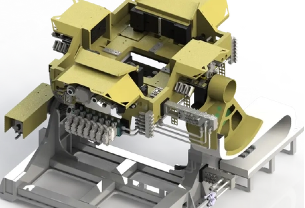
A Horizontal Gravity Die Casting Machine operates with the mold parting line running vertically, while the die halves open and close horizontally. This configuration excels in producing symmetrical parts and components requiring simple core extractions. Foundries frequently deploy these machines for high-volume automotive components like brake calipers, engine mounts, and suspension knuckles. The primary advantage lies in production speed. Horizontal machines facilitate rapid die movements and straightforward integration with robotic ladles and automated part extractors. They also maintain an efficient footprint on the factory floor. However, they offer less control over the initial metal flow velocity compared to tilting models. Because the metal drops directly into the gating system, it is less ideal for highly complex, thin-walled geometries where turbulence must be absolutely minimized.
A Tilting Gravity Die Casting Machine rotates the entire mold assembly during the pouring process. The cycle begins with the mold tilted horizontally. As the metal is poured into the basin, the machine slowly tilts upright. This action allows the molten aluminum to flow smoothly down the mold wall, rather than dropping freely into the cavity. This configuration is essential for complex geometries, thin-walled parts, and components like cylinder heads or intake manifolds. Variable tilt speeds virtually eliminate air entrapment and oxide inclusion by maintaining a continuous, unbroken metal front. The controlled feed also prevents premature solidification in thin sections. The trade-off comes in cycle times. The tilting motion inherently adds seconds to each cycle, making it slower than horizontal machines. Additionally, the mechanical tilting apparatus introduces higher initial machine complexity and requires more rigorous maintenance protocols.
Feature | Horizontal Configuration | Tilting Configuration |
|---|---|---|
Best Application | Symmetrical parts, simple cores | Complex geometries, thin walls |
Cycle Speed | Very Fast | Moderate (due to tilt time) |
Turbulence Control | Moderate | Excellent |
Maintenance Needs | Standard hydraulic upkeep | Higher (tilt mechanism wear) |
Modern casting equipment relies on advanced PLCs to govern every machine movement. These controllers dictate the exact timing of die closure, core insertion, pouring sequences, and part ejection. Connecting advanced PLCs to the casting process guarantees highly repeatable cycle times. Operators can program precise tilt profiles for different molds, ensuring the metal flows exactly as intended every time. This level of automation removes human error from the equation, resulting in consistent part quality across multiple shifts. You set the parameters once, and the machine executes them flawlessly.
Many aluminum components require hollow internal structures or complex undercuts. Robust hydraulic core pulling systems facilitate the casting of these complex internal geometries without manual intervention. The hydraulics provide the immense force necessary to hold heavy steel or sand cores perfectly stable against the pressure of the incoming molten metal. Once the part solidifies, the system automatically retracts the cores before the main die opens. This prevents part distortion and speeds up the ejection process, keeping the cycle moving without manual prying or hammering.
Thermal regulation dictates casting success. Integrated mold heating and cooling circuits maintain the die at the optimal operating temperature. Before production begins, heaters bring the die up to temperature to prevent the first few pours from freezing prematurely and causing cold shuts. During continuous production, the molten metal transfers massive amounts of heat into the die. Water or oil cooling channels strategically placed within the mold block extract this excess heat. This precise thermal management prevents premature solidification in thin walls and extends die life by significantly reducing thermal fatigue.
The material used to construct the mold directly impacts the process. Grey cast iron offers excellent thermal conductivity and natural resistance to thermal shock, making it suitable for many standard aluminum casting applications. However, for high-volume production or parts requiring strict dimensional stability, alloy steels like H13 are preferred. H13 tool steel provides superior wear resistance and maintains its structural integrity over hundreds of thousands of thermal cycles. This ensures the long-term dimensional accuracy of the cast parts, meaning your last casting measures exactly the same as your first.
Transitioning to permanent mold casting requires an upfront investment in metal dies. However, this initial tooling cost must be weighed against long-term operational savings. Metal dies offer exceptional longevity, often lasting for tens of thousands of cycles before requiring major refurbishment. This durability, combined with reduced manual labor and drastically lower scrap rates, generates a strong return on investment. Furthermore, gravity die casting tooling is significantly more cost-effective than the massive, highly complex molds required for high-pressure die casting. This positions gravity casting as the financial sweet spot for mid-to-high volume production runs.
Identifying the break-even point for automation requires analyzing current production volumes. If a foundry is casting a few hundred parts a year, sand casting remains economically viable. However, as production demands scale into the thousands or tens of thousands of units annually, the labor and scrap costs of manual methods become unsustainable. The transition to an automated machine becomes financially viable when the volume justifies the tooling cost, and the required cycle time reduction can only be achieved through mechanization. You have to look at your annual run rates to justify the iron.
Industries like automotive and aerospace demand strict adherence to material specifications. Foundries must consistently meet standards such as IATF 16949. The process control provided by automated casting machines makes this compliance possible. By standardizing cooling rates and eliminating turbulence, foundries can guarantee the mechanical properties of every batch. This verifiable consistency allows manufacturers to confidently supply critical structural components to highly regulated industries without fear of catastrophic field failures.
Subjecting metal dies to thousands of thermal cycles creates immense stress. The constant expansion and contraction lead to die wear, erosion, and heat checking. Left unchecked, these fine surface cracks transfer to the surface of the cast part. Mitigating this risk requires strict maintenance protocols. Operators must apply proper die coatings, such as refractory washes, to insulate the steel from the molten aluminum. Implementing strict pre-heating protocols before pouring and adhering to scheduled preventative maintenance will maximize die lifespan and protect your tooling investment.
Introducing automated machinery changes the required skill set on the foundry floor. Mismanagement of automated systems, incorrect PLC programming, or ignoring safety protocols can lead to machine damage or severe casting defects. Foundries must prioritize vendor-supplied training during installation. Developing standardized operating procedures for every mold and executing phased rollouts allows the workforce to adapt to the new technology safely and effectively. You cannot just drop a machine on the floor and expect the crew to run it without guidance.
Installing heavy casting machinery requires careful facility planning. Space constraints, inadequate concrete foundations, or insufficient hydraulic and electrical infrastructure will halt an installation. Comprehensive pre-installation site audits are mandatory. Foundries must work closely with the equipment manufacturer to map out the layout. Ensure adequate clearance for robotic integration, maintenance access, and material handling before the machine arrives on site. Measure your overhead clearance and check your power drops early.
Mechanized casting equipment is a fundamental quality control mechanism necessary for competitive aluminum parts manufacturing. By taking control of metal flow and thermal dynamics, foundries can eliminate the root causes of porosity and shrinkage that plague manual operations. Match the machine to the geometry. Choose a horizontal configuration for speed and simpler, symmetrical parts. Opt for a tilting machine when turbulence reduction and complex, thin-walled geometries are the primary focus.
Audit your current scrap rates to identify the financial impact of casting defects.
Define the exact part geometry requirements and analyze the natural alloy shrinkage characteristics of your materials.
Consult with equipment manufacturers to obtain accurate cycle time estimates based on your specific production volumes.
Evaluate your facility layout to ensure adequate space and utilities for automated machinery integration.
A: Gravity die casting relies solely on the earth's gravity to fill the mold, resulting in slower fill times but allowing for heat treatment and yielding parts with high structural integrity. High-pressure die casting injects metal at extreme velocities and pressures, which is faster for massive volumes but often traps gas, preventing the parts from being heat-treated.
A: The tilting mechanism controls the flow of molten aluminum, allowing it to run smoothly down the side of the mold rather than dropping freely. This laminar flow prevents the metal front from breaking, stopping air from being folded into the liquid and eliminating gas porosity.
A: Alloys with excellent fluidity and low shrinkage tendencies perform best. Common choices include A356 and 319. These alloys fill complex mold cavities efficiently and respond well to the rapid cooling rates provided by metal dies, resulting in strong mechanical properties.
A: Yes, minor post-cast finishing is typically required. While the process achieves near-net-shape, natural metal shrinkage, the necessity of draft angles for part ejection, and critical mating tolerances usually dictate light CNC machining on specific functional surfaces.
A: A well-maintained metal mold made from H13 tool steel can last anywhere from 50,000 to over 100,000 cycles. Lifespan depends heavily on the complexity of the part, the pouring temperature of the aluminum, and strict adherence to die coating and pre-heating protocols.
A: Horizontal machines utilize hydraulic core pullers integrated into the machine platens. These hydraulic cylinders insert steel or sand cores into the mold cavity before the pour and retract them after solidification, allowing for the creation of complex internal passages.
A: Grey cast iron offers excellent thermal conductivity and resists thermal shock, making it cost-effective for standard runs. However, H13 tool steel provides superior wear resistance and tooling life, making it the preferred choice for high-volume production requiring strict dimensional stability.


