
- All
- Product Name
- Product Keyword
- Product Model
- Product Summary
- Product Description
- Multi Field Search
English
Views: 0 Author: Site Editor Publish Time: 2026-04-22 Origin: Site


Hidden inside many cast parts are the shapes that matter most. Oil passages, water channels, hollow sections, and other internal structures all depend on stable sand cores before metal is poured. That is why a core shooter matters in foundry production. A core shooter machine is used to make sand cores with better consistency, higher efficiency, and stronger process control than manual core making. For companies that need reliable casting quality and smoother production flow, Forland Technology provides core-making solutions that support modern foundry operations.
A core shooter machine produces sand cores that are placed inside molds to create internal cavities and passages in castings. Many metal parts cannot be made properly without these cores, especially when the design includes complex inner geometry. In automotive, valve, pump, and machinery castings, the internal structure is often just as important as the outside shape.
This is why a core shooter machine is not simply a sand-filling device. It is a production system that controls filling, forming, curing, and release. Its real job is to make cores that are accurate enough for the design and strong enough for handling, assembly, and pouring. Once production volume increases or the part becomes more complex, this kind of control becomes much more valuable than manual forming.
Forland Technology develops core-making equipment with that production logic in mind. The goal is not only to make a core, but to help foundries maintain stable daily output and better casting consistency.
The quality of the sand core directly affects the final casting. If a core is weak or dimensionally unstable, the finished metal part may have uneven wall thickness, rough internal surfaces, or shape deviation. In worse cases, the foundry may face scrap, rework, or internal defects that appear only after machining.
That is why core making should never be treated as a minor step. A reliable machine supports better filling, more even curing, and stronger final cores. In other words, the machine helps protect the internal accuracy of the casting before the pouring process even begins.
The process starts with prepared sand matched to the selected core-making method. The machine then shoots the sand into the core box under controlled force so the cavity can be filled completely, including narrow or detailed areas. After filling, the sand core is cured to gain enough strength for removal and later use.
The curing stage depends on the production method. In hot box production, heat helps the binder harden inside the tooling. In cold box production, curing happens through a chemical route at room temperature. Once the core reaches the required strength, the mold opens and the finished core is ejected.
This sequence may sound straightforward, but each stage influences the final result. If filling is uneven, the shape may be incomplete. If curing is unstable, the core may be too weak. If ejection is rough, edges or thin sections may break. That is why a core shooter machine is valued for both efficiency and consistency.
The main sections of the machine include the shooting head, core box, clamping unit, curing section, and ejection system. The shooting head controls how sand enters the cavity. The core box defines the core shape. The clamping unit keeps the tooling stable during operation. The curing section gives the core enough strength, and the ejection system removes it safely.
When these sections work together smoothly, the machine supports a stable production cycle. That is especially important in foundries that need repeatable output over long runs.
Core-Making Step | What Happens | Why It Matters for Casting Quality |
Sand preparation | Sand is prepared for the selected process | Stable material behavior supports better core quality |
Shooting | Sand is forced into the core box | Complete filling improves shape accuracy |
Clamping | The tooling stays closed during the cycle | Better stability reduces dimensional variation |
Curing | Heat or chemistry hardens the core | Proper strength is needed for handling and assembly |
Ejection | The finished core is removed | Smooth release helps prevent breakage |
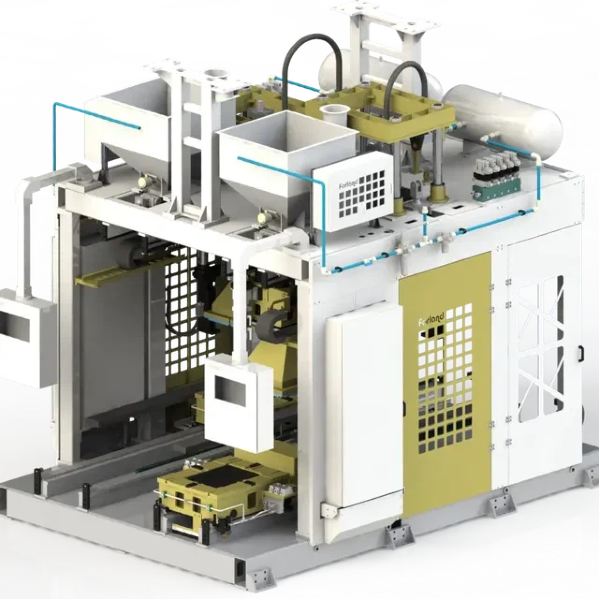
Hot box systems use heated core boxes to cure the sand core. This method is often chosen when a foundry wants a stable cycle and a proven heated curing process. It fits production environments where thermal curing is already part of the workflow and where repeatable rhythm is important.
Forland Technology offers Hot Box Core Shooter Machine solutions as part of its core-making product range. This shows that hot box technology still holds practical value in many foundry applications.
Cold box systems use room-temperature core boxes and chemical curing. This process is widely used in modern core making because it supports efficient production and avoids the need for heated tooling during curing. It is often preferred for applications that require stable output and detailed cores.
Forland Technology also offers Cold Box Core Shooter Machine solutions. According to the company’s product direction, these systems are suitable for cast parts that require dependable core production in demanding applications.
Inorganic systems are increasingly relevant when foundries place more attention on cleaner production and environmental targets. They are not a replacement for every hot box or cold box process, but they are an important part of today’s core-making discussion.
Forland Technology includes inorganic core shooting solutions in its product line as well, giving foundries more process options instead of limiting them to one route.
Foundries move from manual core making to machine-based production because manual methods become harder to control as output rises and part geometry becomes more demanding. Once consistency, speed, and repeatability become major concerns, a machine-based process gives the operation a clearer advantage.
The first benefit is repeatability. A core shooter machine helps reduce variation from one core to the next, which improves downstream mold assembly and casting stability. The second benefit is labor efficiency. Automated shooting and controlled curing reduce the dependence on manual forming work. The third benefit is process integration. Machine-based core making is easier to connect with larger automated production lines.
This fits well with Forland Technology’s position as a company focused on high-end intelligent automatic equipment and production lines for the foundry field. Its product portfolio covers hot core, cold core, and inorganic core shooting production lines, which supports customers looking for more than a basic standalone machine.
A core shooter machine creates the most value in castings where internal shapes are critical. Cylinder heads are a strong example because their internal passages must be accurate and stable. Valve bodies, pump housings, and other precision castings also depend on well-made cores to achieve the required performance.
As the internal geometry becomes more complicated, manual core making becomes harder to keep consistent. A machine-controlled process gives the foundry a better chance of maintaining the required shape and strength through repeated cycles.
This machine is also valuable in production environments where stable output matters every day. Automotive components, machinery castings, and higher-volume core rooms all benefit from more predictable core production. Even when the part itself is not extremely complex, a stable process can reduce disruption and improve overall production control.
That is one reason many customers do not simply ask whether the machine can make a core. They want to know whether it can support a reliable production plan. Forland Technology’s range of hot box, cold box, and inorganic solutions gives customers a broader answer to that question.
A core shooter machine is much more than equipment for shaping sand. It is a core-making system that supports casting accuracy, internal geometry, production efficiency, and process stability. Understanding core shooter technology helps buyers and foundries see why core production has such a strong effect on final casting quality. Forland Technology combines this understanding with practical core-making solutions, including hot box, cold box, and inorganic systems for different foundry needs. If you are planning a new casting project or improving an existing line, contact us to learn more about the right solution, including a Cold Box Core Shooter Machine for your production requirements.
A core shooter machine is used to produce sand cores that form internal cavities, channels, and hollow sections inside cast metal parts. It is widely applied when the casting design includes complex internal geometry.
Core quality affects internal accuracy, surface condition, and dimensional stability. Weak or inconsistent cores can lead to casting defects, shape deviation, or rework during later production stages.
Hot box core shooting uses heated tooling for curing, while cold box core shooting uses a chemical curing process at room temperature. Both methods are widely used, but they suit different production conditions.
Parts such as cylinder heads, valve bodies, pump housings, and other castings with internal channels often require machine-made sand cores to maintain stable shape and quality.


