
- All
- Product Name
- Product Keyword
- Product Model
- Product Summary
- Product Description
- Multi Field Search
English
Views: 0 Author: Site Editor Publish Time: 2025-09-17 Origin: Site


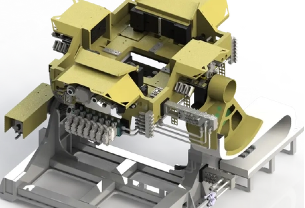
Die casting has become an essential process in modern manufacturing, enabling the production of high-quality metal components with precise dimensions and consistent mechanical properties. Two of the most commonly used methods are gravity die casting and pressure die casting, each with unique characteristics, advantages, and limitations. Gravity die casting involves pouring molten metal into a permanent mold under the influence of gravity, producing durable components with moderate complexity. Pressure die casting, on the other hand, injects molten metal into a mold under high pressure, allowing for extremely fast production and the creation of thin-walled, intricate parts. Understanding the differences between these two methods helps manufacturers select the most suitable approach for their specific production requirements and budget, often involving the use of a Gravity Die Casting Machine for optimized gravity-fed operations.
Gravity die casting, also known as permanent mold casting, is a process in which molten metal is poured into a metallic mold and allowed to fill the cavity solely under the force of gravity. The molds are typically made from steel or cast iron and are designed for repeated use, making the method suitable for medium to high-volume production where durability and consistency are essential.
The metallic mold is preheated and coated with a thin layer of release agent to ensure easy removal of the solidified casting.
Molten metal, commonly aluminum, magnesium, or zinc alloys, is poured carefully into the mold.
The metal solidifies within the mold, with gravity ensuring uniform filling of the cavity.
Once cooled, the mold is opened, and the finished casting is removed. Excess material is trimmed, and the mold is prepared for the next cycle.
Lower Tooling Costs: Permanent molds are less expensive to produce than high-pressure injection dies.
Simple Setup: Gravity casting requires less complex machinery, reducing operational complexity.
Good Surface Finish: Components exhibit smooth surfaces and consistent dimensions.
Durable Components: Parts produced are strong and suitable for structural applications.
Automotive wheels and suspension components
Cylinder heads and engine brackets
Industrial machinery parts requiring moderate complexity
A Gravity Die Casting Machine enhances this process by controlling the pouring rate, mold handling, and temperature, ensuring consistent results and minimal defects.
Pressure die casting is a high-speed production process where molten metal is injected into a mold cavity under significant pressure, typically ranging from hundreds to thousands of tons. This method enables the production of thin-walled, intricate components at high volumes.
Molten metal is prepared and heated to a precise temperature suitable for the alloy being used.
The metal is injected into a steel die at high pressure using specialized machinery.
The high-pressure injection ensures the mold cavity is filled completely and quickly, even for complex geometries.
The component solidifies under pressure, and the die is opened to remove the casting.
High-Speed Production: Multiple cycles per minute allow for mass production.
Thin-Walled Parts: High pressure enables the creation of lightweight components without compromising strength.
Complex Geometries: Injection pressure ensures the mold is filled completely, accommodating intricate shapes and detailed designs.
Consistency: Tight control of temperature, pressure, and cycle time ensures uniformity across thousands of parts.
Higher Tooling Costs: Steel dies are expensive and require precise machining and maintenance.
Complex Equipment: Pressure die casting machinery is more sophisticated and requires skilled operators.
Consumer electronics housings
Automotive engine blocks, housings, and brackets
Appliances and precision industrial components
Gravity die casting relies on gravity to fill the mold, resulting in slower metal flow and less capability for extremely thin sections.
Pressure die casting uses forced injection under high pressure, allowing the metal to fill intricate cavities rapidly.
Gravity die casting molds, while durable, experience moderate wear and have a lifespan dependent on casting frequency.
Pressure die casting molds are designed for high-volume production with controlled cycles, often outlasting gravity molds due to precise temperature and pressure control.
Gravity die casting is suitable for medium-volume production, where moderate complexity and durability are needed.
Pressure die casting excels in very high-volume runs, producing thousands of parts consistently per day.
Gravity die casting is generally limited to moderately complex shapes without extremely thin walls or intricate undercuts.
Pressure die casting can accommodate highly detailed designs, thin walls, and complex internal geometries.
Gravity die casting has lower initial tooling and equipment costs, making it more cost-effective for smaller production runs.
Pressure die casting has higher upfront costs but becomes more economical for mass production due to speed and repeatability.
Gravity die cast parts have smooth surfaces but may require minor finishing.
Pressure die cast components have excellent surface finish and tight tolerances, often requiring minimal post-processing.
Medium-volume automotive components like wheels, engine brackets, and cylinder heads
Aerospace structural brackets and housings
Industrial machinery components requiring moderate complexity and durability
Mass-produced consumer electronics enclosures
Automotive housings, engine blocks, and transmission components
Household appliances and precision industrial parts where volume and intricate shapes are critical
Manufacturers often select gravity die casting when durability, moderate complexity, and medium volumes are priorities, whereas pressure die casting is chosen for mass production of thin-walled, highly intricate components.
Lower tooling costs and simpler setup
Reusable metallic molds provide durability
Moderate production speed suitable for medium volumes
Good surface finish and dimensional consistency
Limited complexity and wall thinness
Slower production than high-pressure methods
High-speed production with consistent quality
Ability to produce thin-walled, complex parts
Excellent surface finish and tight tolerances
Efficient for very high-volume production
High initial tooling and equipment costs
Requires complex machinery and skilled operators
Not as cost-effective for small or medium production runs
When deciding which process to use, manufacturers should consider:
Part Complexity: Moderately complex parts are well-suited for gravity die casting, while intricate, thin-walled components require pressure die casting.
Production Volume: Medium-volume runs favor gravity casting, whereas high-volume, repetitive production benefits from pressure die casting.
Cost and Budget: Gravity casting has lower initial costs, but pressure die casting offers better long-term efficiency for mass production.
Material Selection: Both processes accommodate common alloys, but pressure die casting is particularly suitable for lightweight metals like aluminum and zinc.
Surface Finish Requirements: Pressure die casting provides superior surface quality and tolerances, reducing post-processing.
Using a Gravity Die Casting Machine ensures that gravity-fed parts are consistent and reliable, making it an excellent choice when simplicity, durability, and medium-volume production are required. Pressure die casting, while more expensive initially, is indispensable for industries that demand rapid, high-volume production with intricate geometries.
Gravity die casting and pressure die casting each play unique roles in modern manufacturing. Gravity die casting, often performed with a Gravity Die Casting Machine, is cost-effective for medium-volume production of durable, moderately complex parts, providing good surface finish and consistent quality. Pressure die casting, in contrast, is ideal for high-volume production, enabling thin-walled, highly detailed components with exceptional precision and speed. Choosing the right process depends on factors such as production volume, part complexity, surface finish requirements, and budget considerations. Manufacturers must weigh initial tooling costs against long-term efficiency to ensure optimal results. To explore tailored casting solutions, enhance production quality, and find the best approach for your industry, consider contacting Wuxi Forland Technology Co., Ltd., a trusted expert in advanced casting technologies for automotive, aerospace, electronics, and industrial applications.


